
Supporting an athlete aged 13–16 without taking away their voice

They are driving home from a competition. His father asks about the result; the athlete looks out of the window. Eventually he says, “Coach told me to start more steadily.” “But you could have pushed harder from the beginning,” his father replies. The conversation takes a minute. The next day, the boy arrives at training with two ideas about what he should do, and a feeling that he will disappoint one of the adults.
Tension like this does not require bad intentions. A parent sees their child’s effort and wants to help. A coach has a plan. Both want progress, but sometimes they speak about it differently. In the middle is a teenager trying to work out what is expected of them.
Cooperation begins when adults stop communicating through the athlete and find a way to talk directly, with the young person involved.
A parent does not need to be a second coach
From the stands, you see a lost ball, a poor turn or a weak finish. You are less likely to see the purpose of an exercise, the stage of preparation or the task assigned for that competition. “You need to try harder” can therefore miss what the athlete is actually working on.
Parents, however, know things a coach often does not. They know their daughter has spent three evenings studying for a test. They notice their son falling asleep in the car or increasingly putting down his kit bag without a word. They know the cost of travelling and when dinner really happens after training.
This information matters alongside times and results. It helps explain the conditions in which sporting progress takes place.
It is worth agreeing that the coach guides the sporting work while the parent helps make life outside training visible. That division does not close off questions about safety or concerns about how a child is treated. It does give home a chance to remain a place of rest, rather than becoming another team briefing.

Three perspectives, a shared direction. Parents know everyday life beyond training, coaches guide the sporting work, and athletes bring their own goals and experiences.
First, ask what the athlete wants
“We want them to take the next step” sounds reasonable. But do they understand that step in the same way?
For a parent, it may mean moving to a stronger group. For the coach, it may mean patiently learning a technique. For a fifteen-year-old, it might mean rebuilding confidence after a poor competition, or continuing to train with friends. Until these expectations are spoken aloud, different goals can easily be mistaken for a lack of ambition.
Give the athlete the first turn: “What would you like to improve next month? What have you felt pleased with recently? What is hardest right now?” Adults do not have to like every answer immediately. They do need to understand the starting point.
The International Olympic Committee’s consensus on youth athletic development considers relationships with parents and coaches and the risks of unrealistic expectations. The conversation suggestions here offer a practical way to organise cooperation, rather than a fixed protocol for every family. IOC consensus.
Let fatigue be information
If “I’m tired” is met with “So is everyone else,” the athlete may say nothing next time. Adults then lose information they wanted to use to plan training well.
Checking every rating at home can have a similar effect. When a parent starts asking why today’s readiness was three rather than four, a questionnaire can become another test. The athlete learns to choose the answer that ends the conversation.
Explain why the information is being collected: to understand the situation and discuss it. Reporting a difficulty does not automatically mean missing training. It means the coach should look into what is happening.
The AAP notes that young athletes may experience winning as an expectation from family and coaches. It encourages parents to value their child beyond results. That provides a useful starting point for everyday conversation: take an interest in their experience before judging it. American Academy of Pediatrics guidance.
One agreement is better than five pieces of good advice
Imagine a fourteen-year-old athlete. She has two late training sessions, extra activities on Saturday and an important school test on Friday. Her parent notices growing fatigue. Her coach sees that maintaining exercise quality is becoming harder. She says she does not want to miss anything because she is afraid of falling behind.
The conversation could get stuck on whether she needs more discipline or more rest. It could also turn to specifics.
What is already in the plan? Which sessions are additional? When does her day actually end? What does she consider the biggest difficulty? After that conversation, the coach can agree on a change, the parent can help with transport, and the athlete can say whether the proposed solution is workable.
Finish with a clear agreement: what will happen, who is responsible and when everyone will check back. “On Friday, we’ll see how these three days went” is more useful than “We need to take recovery more seriously.”
This is an example of organising cooperation, not a suggestion that similar weeks always call for the same solution.
Where VANTARO can help
A good conversation is easier when it does not begin with reconstructing a schedule from several messages and three people’s memories.
In VANTARO’s calendar, a parent can check their child’s training and events. It provides a reference for discussing the week: when sessions happen, where competitions fall and what needs to be considered for transport and other responsibilities. School and home life still need to be added to the conversation; the training calendar cannot explain them on its own.
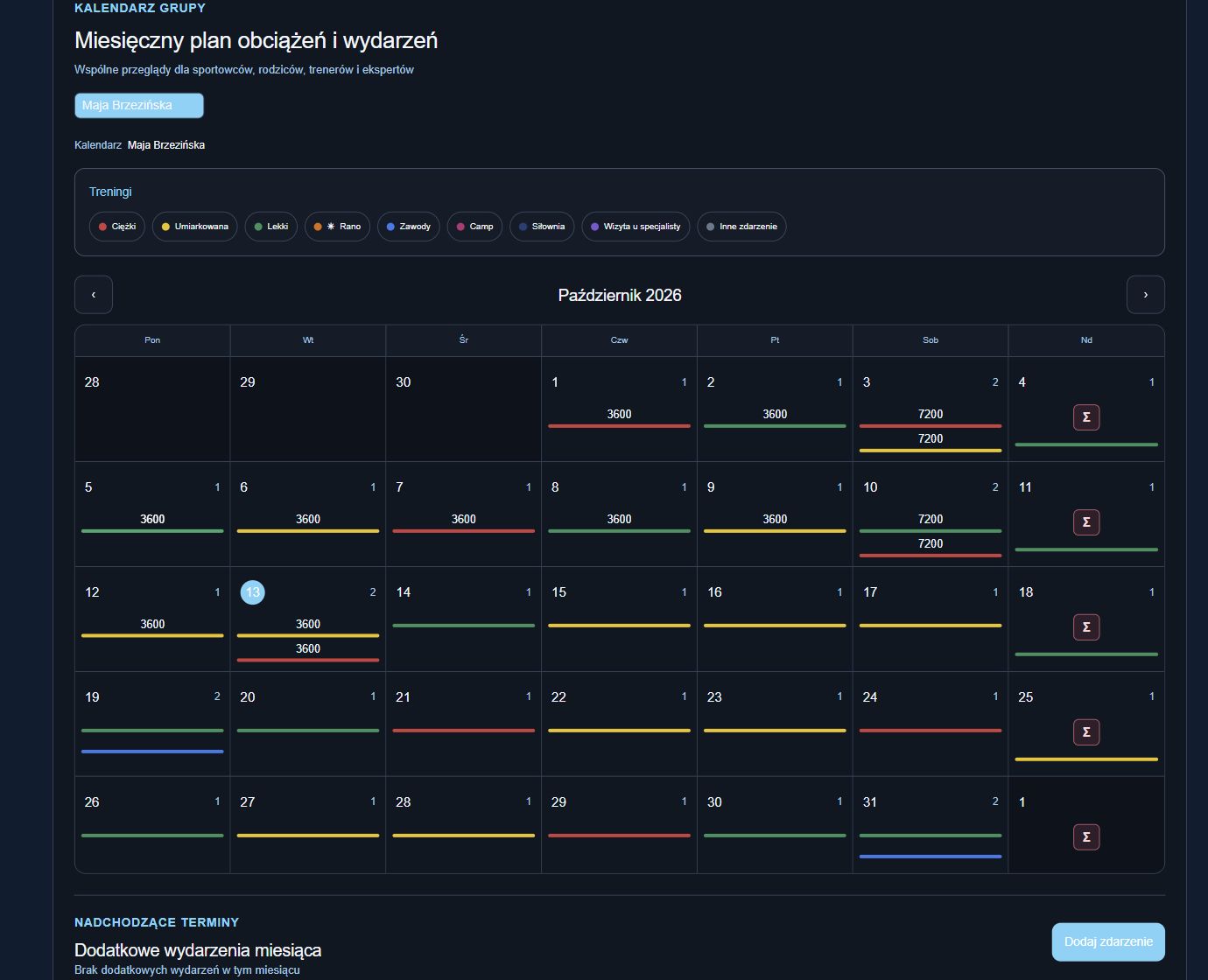
The parent’s calendar. Daily swimming sessions of varying intensity and competitions in one place make it easier to organise the week.
A shared schedule does not replace a conversation. The parent contributes knowledge of everyday life, the coach explains the purpose of the sessions, and the athlete describes how the week feels. Seeing the same dates makes it easier to agree on a change and avoid leaving the teenager to carry conflicting arrangements between adults.
Parents and coaches may have different access permissions. Explain to the athlete who can see their responses and how those responses will be used. Trust is difficult to build if they only find out who can read something after entering it.
Leave room for their own sport
After a disappointing competition, you can ask, “Would you like to talk about it now or later?” After a good session, you can simply enjoy it together. Every afternoon does not need an analysis, and every difficulty does not require a meeting of all the adults.
Cooperation between coach and parent should help the athlete know whom to approach with a problem, understand agreements and feel able to say what they think of them. Over time, they should contribute more to those conversations themselves.
The best sign that adults are working together is not that the teenager has stopped asking questions. It is that they no longer have to choose which adult they can tell the truth to.
The calendar illustrates one athlete’s example schedule, not a recommended training pattern for every swimmer aged 13–16.